AI · Energy Analytics · Academic project
AI-Based Load Forecasting
Short-term electrical load prediction from historical and weather data.
8
Models Evaluated
~2.55% MAPE
Best Accuracy
CNN-LSTM Hybrid
Best Model
Overview
Accurate short-term electrical load forecasting is essential for maintaining grid stability, optimizing power generation, and improving energy efficiency. This project develops an end-to-end forecasting pipeline using historical load patterns, weather information, and engineered temporal features to predict future electricity demand.
Multiple machine learning and deep learning models were developed and evaluated, demonstrating how feature engineering, time-series preprocessing, and model selection together influence forecasting accuracy for real-world energy systems.
Problem
Power utilities require accurate short-term load forecasts to balance electricity generation, minimize operational costs, and maintain grid reliability. This project develops a data-driven forecasting pipeline using historical demand and weather data to evaluate multiple machine learning and deep learning approaches for reliable short-term load prediction.
Process
Data pipeline
Historical load merged with weather-station features (temperature, humidity, wind) on a shared hourly timestamp index, with interpolation handling for missing intervals.
Feature engineering
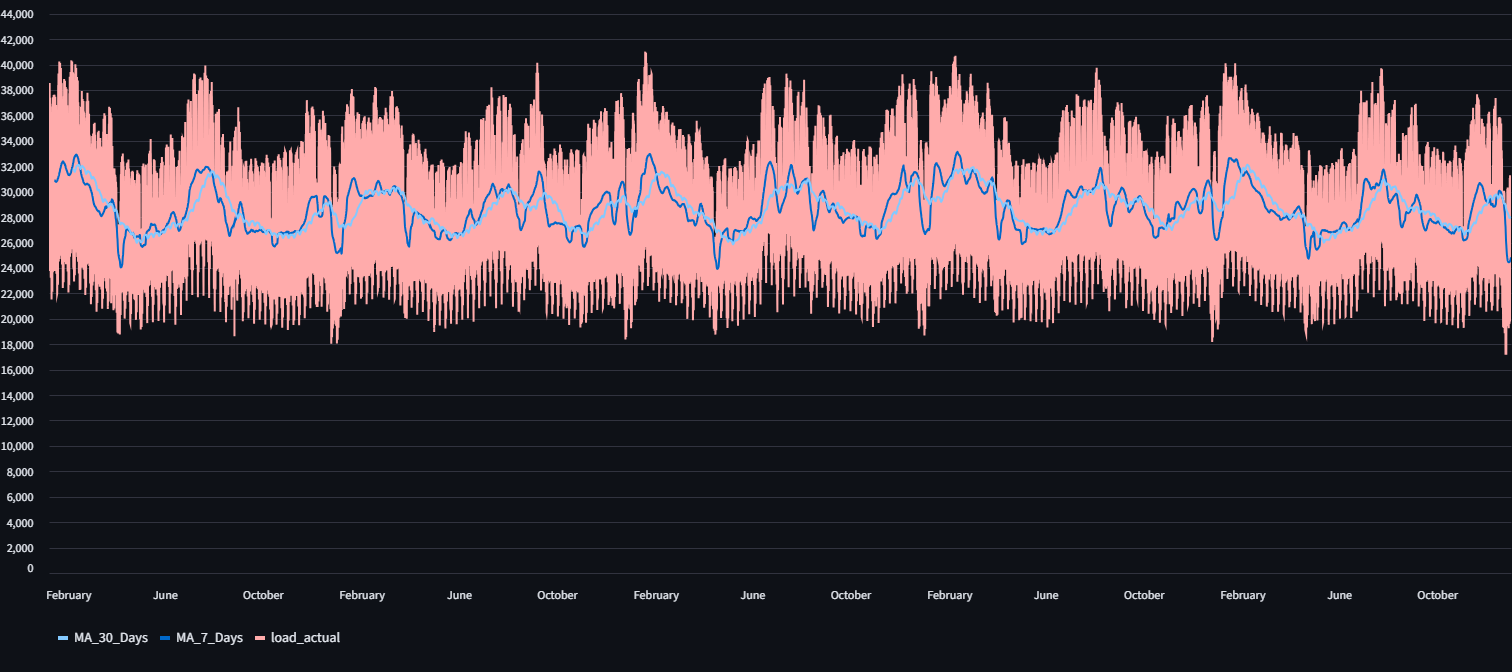
Lag features, rolling means, and calendar features (hour-of-day, day-of-week, holiday flags) engineered to capture demand seasonality — this step moved the accuracy needle more than model choice did.
Model development
Developed and evaluated multiple forecasting models including Linear Regression, Decision Tree, Random Forest, Support Vector Regression, LSTM, GRU, CNN, and a CNN-LSTM hybrid architecture to compare traditional machine learning with deep learning approaches.
Walk-forward validation
Time-ordered, walk-forward validation instead of a random train/test split — critical for time-series data, since a random split silently leaks future information into training and produces misleadingly good numbers.