AI · Predictive Maintenance · Academic project
Motor Health Prediction
Predictive maintenance for electric motors from current and voltage signal parameters.
Current & Voltage
Input Signals
Machine Learning
Approach
Predictive Maintenance
Application
Overview
Electric motors are critical components in industrial systems, and early fault detection can significantly reduce downtime and maintenance costs. This project explores the use of machine learning to predict motor health by analyzing electrical parameters such as current and voltage, eliminating the need for additional sensing hardware.
By combining data preprocessing, feature engineering, and supervised learning techniques, the project demonstrates how electrical signal analysis can support predictive maintenance and enable more informed maintenance decisions.
Problem
Unexpected motor failures can lead to costly downtime and reduced operational efficiency. This project investigates whether electrical parameters such as current and voltage can be used to identify motor health conditions using machine learning, providing an economical alternative to traditional vibration- or thermal-based monitoring approaches.
Process
Signal acquisition
Motor current and voltage measurements were collected from different operating conditions to create a dataset representing both healthy and faulty motor behavior.
Feature extraction
Statistical features were extracted from the electrical signals to capture meaningful characteristics that distinguish healthy operating conditions from potential fault scenarios.
Classification
Supervised machine learning models were trained and evaluated to classify motor health conditions based on the extracted electrical features, with performance assessed using standard evaluation metrics.
Maintenance signal output
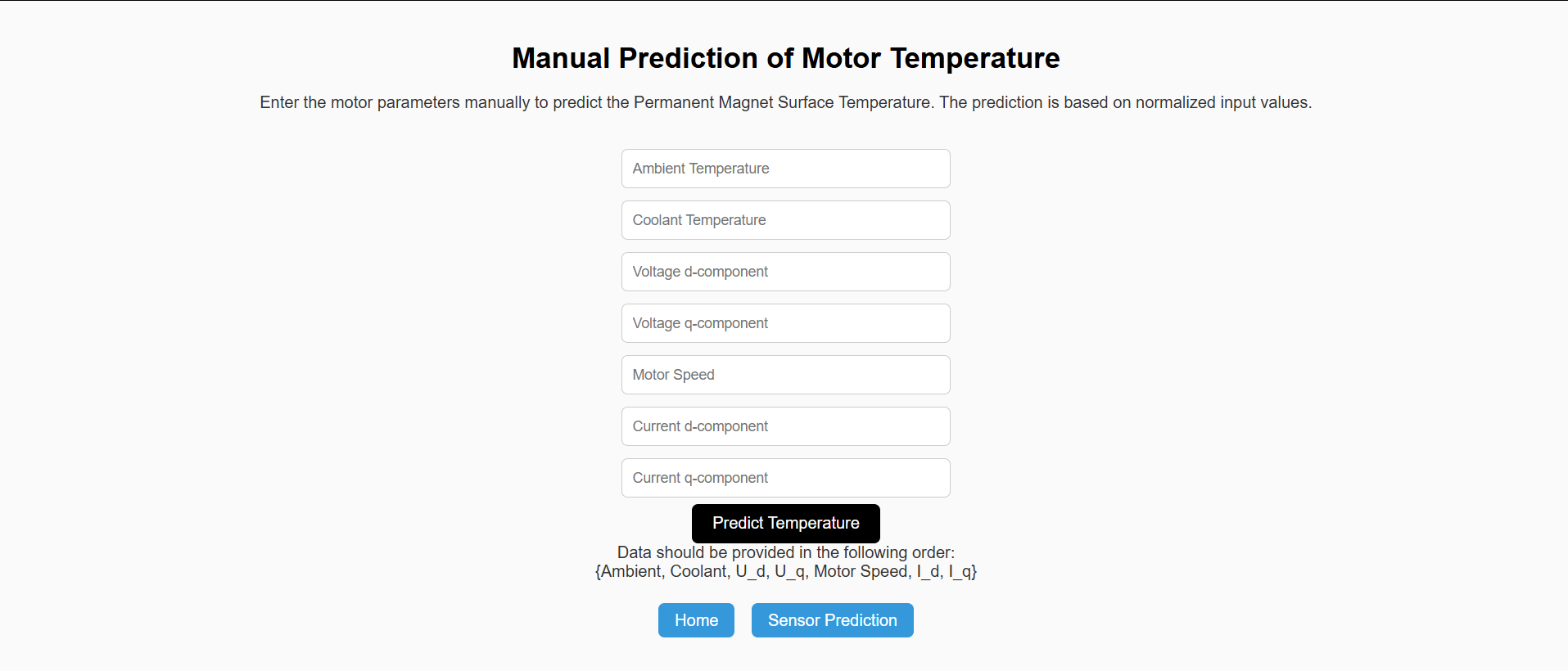
The predicted motor health status was presented as an interpretable output that could support preventive maintenance planning and operational decision-making.